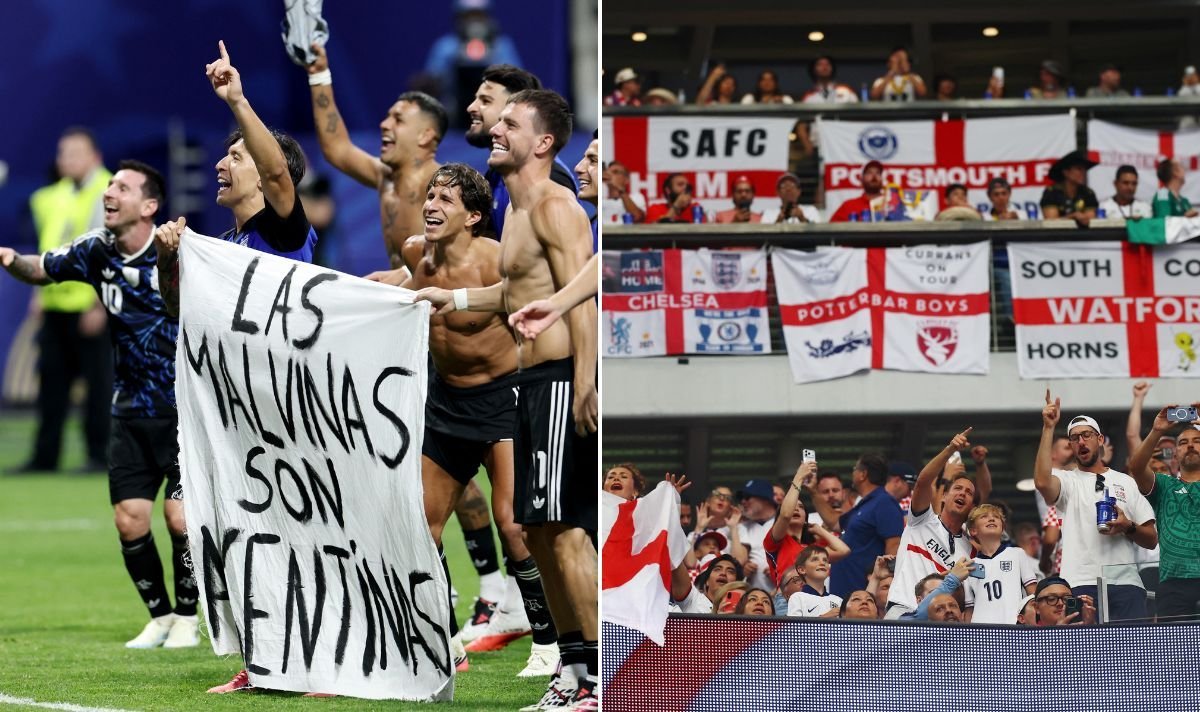
FIFA loves to present itself as the moral conscience of world football. It speaks endlessly about respect, inclusion and keeping politics out of the beautiful game. Yet when it comes to applying those principles consistently, the governing body appears to have a remarkable blind spot.The latest controversy exposes precisely why so many supporters have lost faith in FIFA’s claim to political neutrality.Following Argentina’s victory over England, Argentine players were widely reported to have displayed a banner proclaiming that the Falkland Islands belong to Argentina. Whatever your view of the sovereignty dispute, there can be no serious argument that this was a political statement. It was not simply a celebration of footballing success; it was a direct assertion about a long-standing territorial dispute between two nations.Cameras captured several members of the South American squad posing with the banner | GETTYAnd yet there appeared to be no immediate intervention from FIFA.Contrast that with reports that an England supporter was instructed to cover part of an England flag because it featured the crest of Barrow AFC, whose badge includes a submarine. The implication was that this somehow breached tournament regulations or was considered politically sensitive.If those reports are accurate, the contradiction is staggering.One banner advances a geopolitical claim over British sovereign territory. The other displays the badge of an English football club whose emblem reflects the town’s proud shipbuilding heritage. One is permitted to remain on show in front of the world’s cameras; the other is deemed unacceptable.A Barrow flag with a submarine was banned from entering the stadium by FIFA when England faced Croatia | REUTERSHow exactly does FIFA justify that?The organisation cannot have it both ways. Either political messaging has no place on the football pitch, or it does. If the rules prohibit political displays, they should apply equally regardless of whether the message comes from Argentina, England or any other nation. Selective enforcement is not neutrality; it is inconsistency.For British supporters, the issue goes beyond football. The people of the Falkland Islands overwhelmingly voted in 2013 to remain a British Overseas Territory.Their right to self-determination has long been recognised as central to the UK’s position. To allow football’s biggest stage to become a platform for challenging that while simultaneously restricting an England fan over a club badge understandably strikes many as deeply unfair.Fifa chief Gianni Infantino has already faced calls to resign during the World Cup over corruption allegations | REUTERSFootball should unite people. FIFA repeatedly reminds us that the game is for everyone and should rise above political disputes. Those are admirable principles. But principles only matter if they are applied consistently.Supporters are entitled to ask why one political message appears to receive a free pass while another display, with no obvious political intent, faces restriction.Until FIFA can provide a coherent answer, accusations of hypocrisy will continue to grow. The organisation’s credibility depends not on lofty slogans but on fair, transparent and even-handed decision-making. On this occasion, many fans will conclude that FIFA has fallen well short of the standards it so often demands of everyone else.