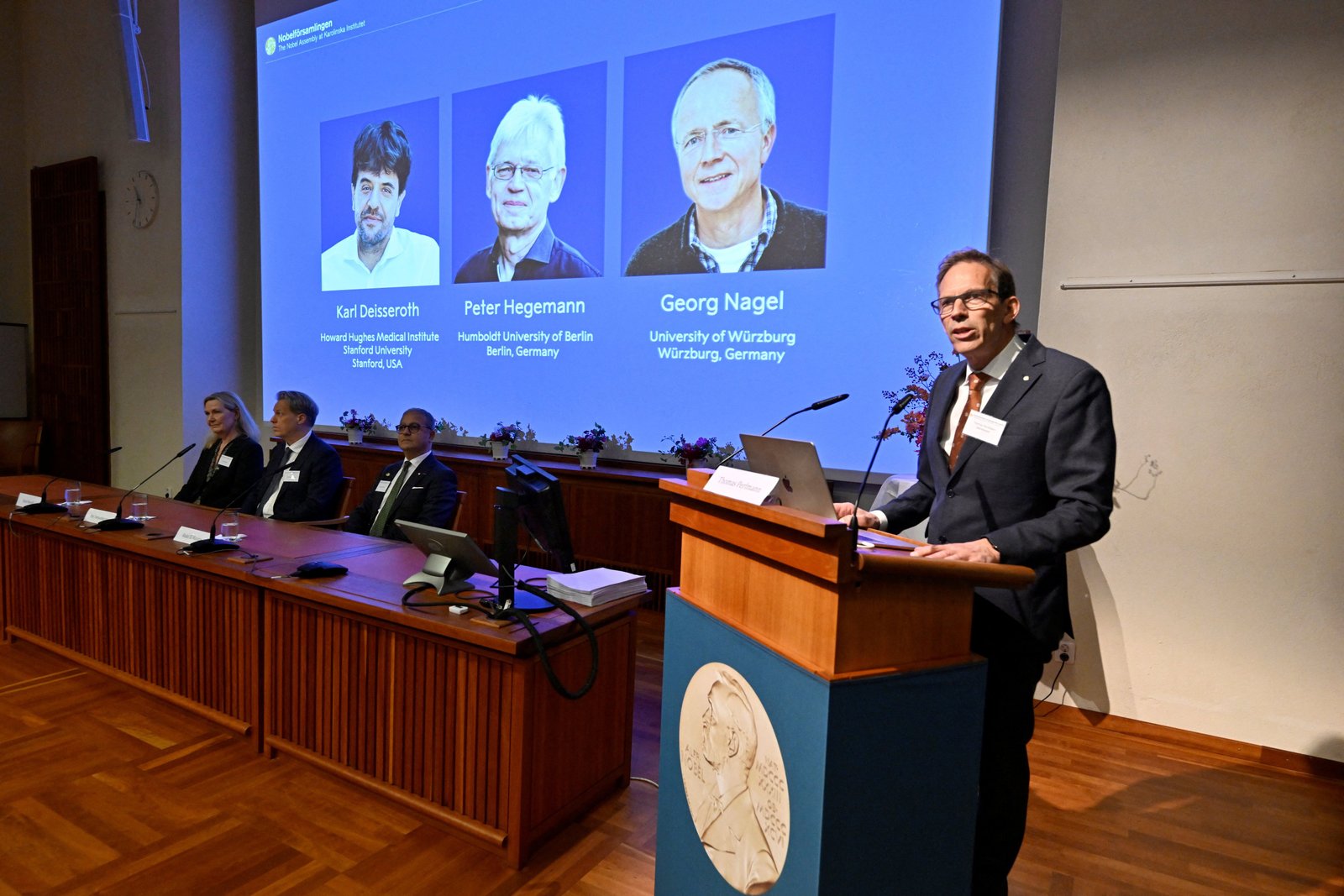
The Nobel Prize in Physiology or Medicine has been awarded to scientists who developed a new technique to study brain cells. American Karl Deisseroth and Germans Peter Hegemann and Georg Nagel developed optogenetics, which uses light to control individual nerve cells in the brain.The Nobel Assembly of Sweden’s Karolinska Institutet said Mr Deisseroth, 54; Mr Hegemann, 71; and Mr Nagel, 73, had been selected for their “discoveries concerning light-gated ion channels and optogenetics.”Thomas Perlmann, Secretary-General of the Nobel Assembly at Karolinska Institutet, said: “This method makes it possible to switch on, or off, the activity of individual nerve cells in a living brain.”Anna Wedell, a professor of genetics and a member of the Nobel Committee for Physiology or Medicine, said a new era in neuroscience had opened, but it was only the beginning.She said: “For the first time, we can actually start to understand how the brain processes information and how different neurons interact across the brain.”The trio will share a prize sum of 12 million Swedish crowns (£904,482).The winners of the Nobel Prizes are being published throughout the week, with the 2026 Nobel Peace Prize to be announced on Friday.Karl Deisseroth, Peter Hegemann and Georg Nagel are awarded the 2026 Nobel Prize in Physiology or Medicine | REUTERSMr Deisseroth said he was still awake in the early hours when he was called from Stockholm.He said: “I was not yet asleep, being a night owl, and now I don’t think I’ll be able to sleep for quite a while.”Mr Hegemann said he was overwhelmed to get a call from a number he recognised as being in Sweden, adding: “It’s unbelievable when you get this message.”Mr Nagel said he was sitting on a terrace “in a nice little village outside Naples” when the call came through, telling reporters: “I actually thought it would not happen, but some other people always told me this will happen.”Karl Deisseroth was one of the winners | REUTERSKarl Deisseroth was one of the winners of the prestigious prize | REUTERSNobel Prize winner in medicine Georg Nagel | REUTERSMr Deisseroth was training to become a neurosurgeon when he encountered patients he could not help at a psychiatric clinic. That encounter, witnessing suffering he had no tools to treat, prompted him to question why the brain works so differently in different people.The answer would come from an unexpected place: an alga, and two German scientists driven by equally simple curiosity.Mr Hegemann, fascinated by exploration and unknown territory, began investigating in the early 1990s how the alga Chlamydomonas reacts to light in half a millisecond.He hypothesised that a single protein both captured light and acted as an ion channel, and he contacted Mr Nagel to ask him to test it.An algae strain of Chlamydomonas reinhardtii provided the answer | REUTERSMr Nagel said of the original call from Mr Hegemann: “This was a good chance to do something new and exciting.”Their conversation led him to inject Chlamydomonas genes into frog eggs and discover channelrhodopsin-2, a light-sensitive ion channel.In 2003, Nagel and Hegemann published findings showing the protein could be introduced into human cells to generate electrical impulses using light. Deisseroth showed the technique in rat nerve cells in 2005, and the method was named optogenetics in 2006.In 2007, a scientist at Hegemann’s Max Planck Institute in Frankfurt recalled researchers taping optical fibres salvaged from Christmas decorations to microscopes.The winners were announced during a press conference at the Nobel Forum at Karolinska Institute in Stockholm | REUTERSDima Kuzmin, a neurochemist at the time, said, “We didn’t really know how it worked; we didn’t really have any tools. It was massively exciting.”Animal models are being used to understand schizophrenia, Alzheimer’s disease, Parkinson’s disease, epilepsy and addiction, conditions that affect millions of people worldwide and have limited treatment options.Researchers are also applying the technique to try to restore vision to people blinded by retinitis pigmentosa, a progressive eye disease, by inserting a light-sensitive protein into the retina. They also hope optogenetics could improve cochlear implants, potentially allowing more precise stimulation of the auditory nerve than current electrical devices.Paul Bresge, CEO of US biotechnology company Ray Therapeutics, which is developing a therapy to treat retinitis pigmentosa, said: “When you think about it in the retina, all patients need to do is open their eyes, and you have the light. So it makes a lot of sense as a potential therapy.”