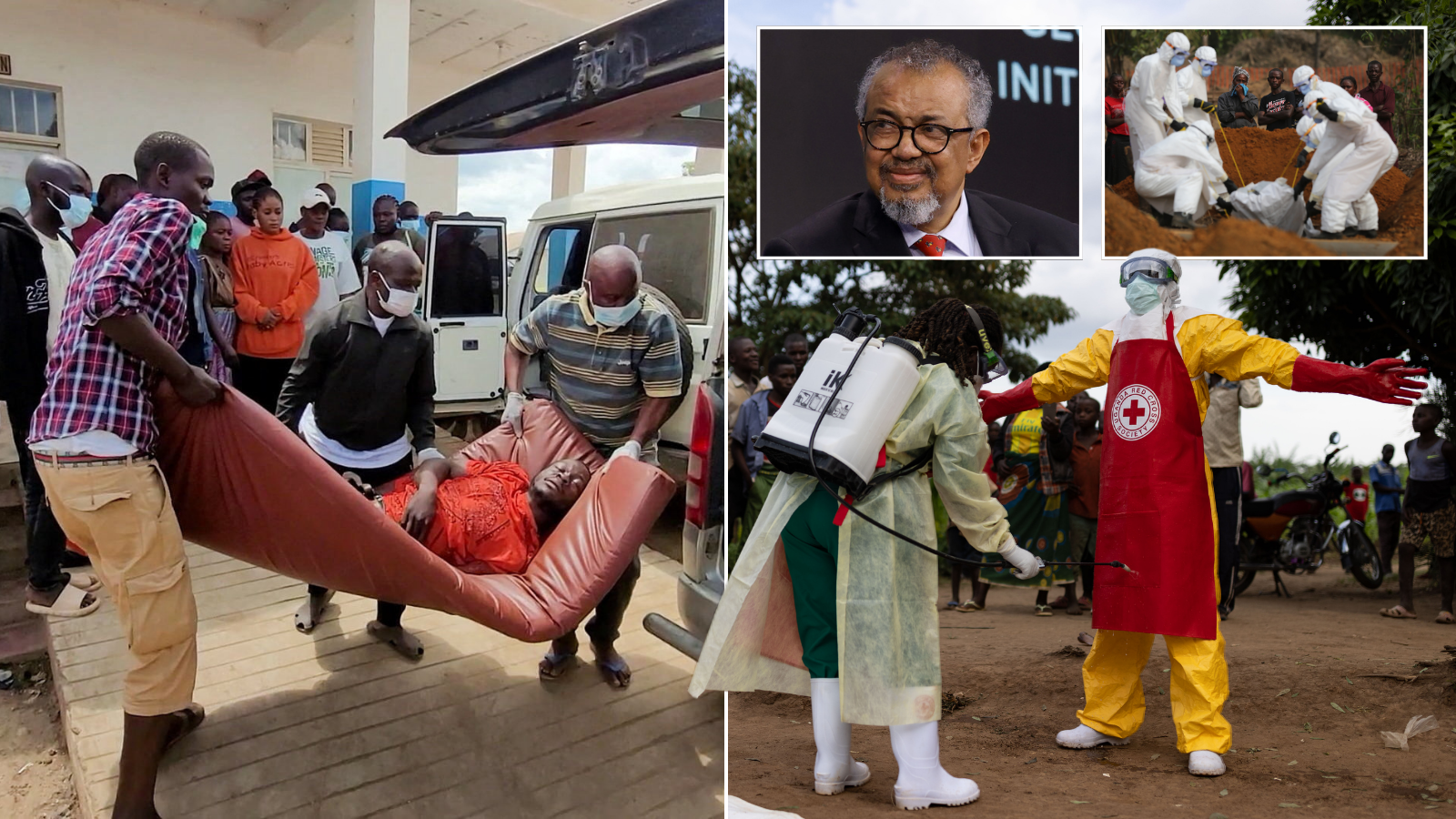
The World Health Organisation has declared an “international public health emergency” after a deadly epidemic of Ebola in Africa.The disease has been caused by the Bundibugyo virus, a disease closely related to the Ebola virus which currently has no vaccine.So far, eight confirmed cases, 246 suspected cases and 80 suspected deaths have been reported in the Democratic Republic of the Congo (DRC).Four of the dead are healthcare workers, the WHO said.Further cases have been picked up in neighbouring Uganda, though the outbreak has not yet met the criteria of a pandemic emergency.And in a chilling update, experts say the outbreak may have already been spreading for more than three weeks unseen.The WHO said all the signs “point towards a potentially much larger outbreak than what is currently being detected and reported”.While Dr Jean Kaseya, director general of the Africa Centres for Disease Control and Prevention, said officials have still not found patient zero.PICTURED: A man is carried from an ambulance as he arrives at hospital in the DRC following confirmation of an Ebola outbreak involving the Bundibugyo strain | REUTERSEarly investigations suggested the first case of the outbreak came in the third week of April, Dr Kaseya said.He added: “So far we don’t know the index case. It means we don’t know the magnitude of this outbreak.”The virus is extremely contagious, which has sparked concerns due to its spread in an area with busy cross-border traffic and migration.Dr Tedros Ghebreyesus, the WHO’s Director General, said the organisation would be calling an emergency meeting as soon as possible to work out what to do.
OUTBREAK FEARS – READ MORE:
PICTURED: A family watches as a burial team lowers their loved one into a grave in Liberia in 2015. The WHO has called for ‘safe and dignified’ burials so the disease cannot spread further | GETTYBut the WHO demanded that “no country should close its borders or place any restrictions on travel and trade”.”Such measures are usually implemented out of fear and have no basis in science,” it said.It has, however, called for cross-border screening in the affected areas to ensure that no suspected case is missed.Anyone who is known to have contracted the Bundibugyo virus has been told not to travel internationally whatsoever, unless the travel is part of an appropriate medical evacuation.PICTURED: WHO chief Dr Tedros Ghebreyesus. The WHO has demanded that ‘no country should close its borders or place any restrictions on travel and trade’ | GETTYThe WHO has called for “safe and dignified” burials so the disease is not passed on from the dead.Dr Kaseya confirmed there is no vaccine for the Bundibugyo strain of Ebola, unlike the more common Zaire variant.However, there are candidates in early trials for the jab, he added.This marks the DRC’s 17th Ebola outbreak since the virus first emerged in the country in 1976.The country has spent decades trying to build surveillance networks to spot and beat outbreaks.