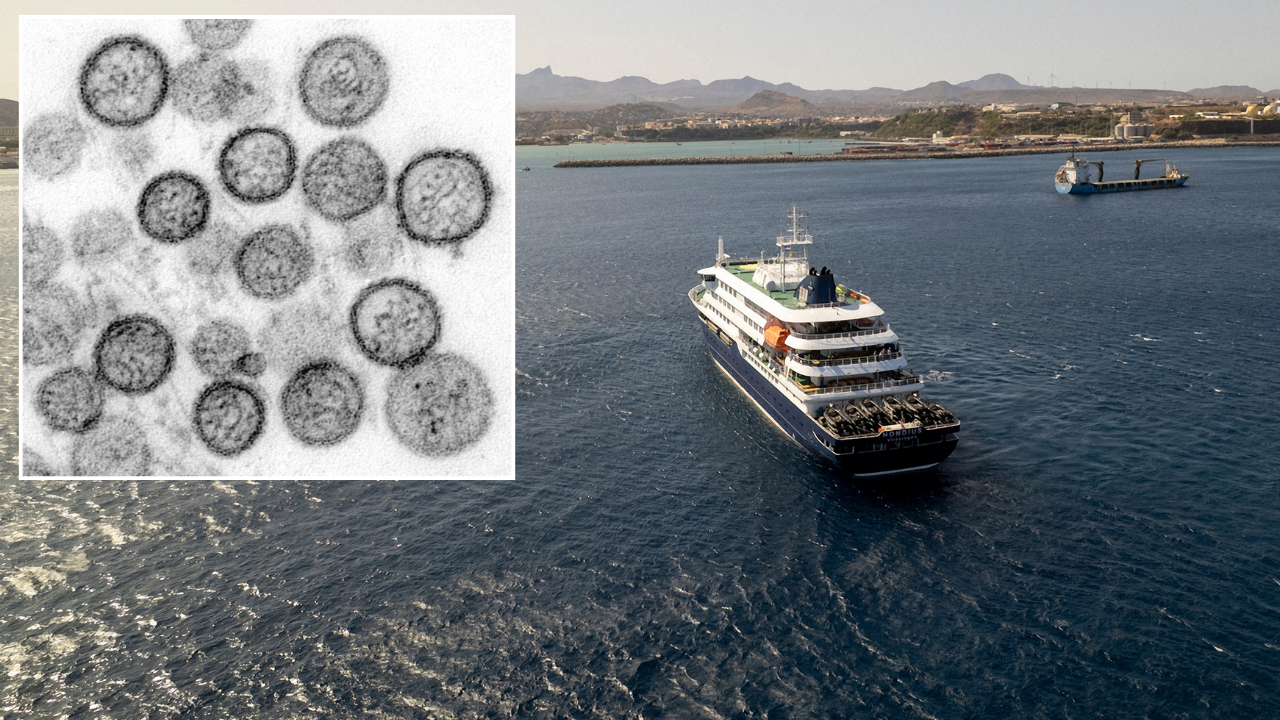
Scientists are racing to unravel the genome of a deadly hantavirus strain amid fears it may have mutated into a more transmissible form.The news comes after a terrifying outbreak aboard a cruise ship has left passengers trapped in isolation on the cruise liner.A leading scientist at the centre of the international investigation said experts are urgently carrying out genomic sequencing to discover whether the virus spreading on board the MV Hondius has become more transmissible.He said: “Scientists will be looking at everything including mapping the genome to see if there are mutations there making it more transmissible.”Health officials now believe a Dutch couple who later died may have contracted the virus during a bird-watching excursion near Ushuaia in southern Argentina before unknowingly bringing it aboard the expedition vessel.The scientist said a key part of the investigations will focus on a landfill site, popular for bird watching, and visited during a cruise excursion, where infected rodents and other small mammals may have contaminated the area. He said: “The contamination is in the grounds and it is the dry soil and dust, which can be virus-laden from the rodents’ faecal droppings and urine. Inhalation of this fine dust may be the source of initial infection.”He added: “It is well known that many small mammals including rats, mice, shrews and bats carry the strain of hantavirus in Argentina and other countries of the Americas.”The Andes strain of hantavirus – is considered to be capable of spreading between humans – is now at the heart of an extraordinary international health operation involving the UK Health Security Agency, foreign governments and infectious disease experts.Authorities fear the couple may have infected fellow passengers during the voyage after boarding the ship while unknowingly contagious. Or it may be that other people on this expedition were exposed and infected at the same time.Health professionals are scrambling to contain the hantavirus outbreak | GETTY“It’s a waiting game and only a matter of time before we find out if there will be more cases because the incubation period is up to eight weeks. This may be one exposure in one place event or it may be person to person transmission after the initial exposure of a few or just the initial two index cases. Until you have interviewed people we cannot know about their movements and thus exposure.”Investigators may also examine whether the ship’s ventilation systems may have contributed to the spread.“The ship may not have had a special filter known as a HEPA filter which is on board modern planes,” the scientist added.Passengers and crew who travelled on the ship have now been placed into strict isolation and are being closely monitored for symptoms, with some facing weeks in quarantine because of the virus’s unusually long incubation period.Transmission between individuals in proximity may be taking place | GETTYLeading communicable diseases expert Dr Bharat Pankhania, former senior clinical lecturer at the University of Exeter, said the outbreak was highly unusual: “We have not seen similar outbreaks on board expedition cruise liners, he stressed it was not likely to spiral into a global pandemic or a huge upsurge in number of new cases being created.He said: “The key message is that this incident is well contained, the focus is on the passengers of the ship and their close contacts. Inevitably there may be more cases as everyone on the ship is a contact who may have been exposed to the virus.“But it is not easily transmitted from human to human so we are not talking about an explosive rise in the number of cases.”Dr Pankhania warned, “Unfortunately the Andes strain of the virus which is found in the New World can lead to a more serious form of the illness. One feature of this infection is a deadly lung condition known as Hantavirus Cardiopulmonary Syndrome.”Dr Pankhania added that globally people exploring remote wilderness areas, together with deforestation and habitat loss is leading to an increased risk of people coming into contact with infections that can transmit from animals to humans.He said: “People venturing into caves, deep forests, and or deforestation will expose them to normally rare and unusual disease-causing agents. In my view this is unlikely to be rats on the ship.”He added: “Passengers still on board the liner will be encouraged to isolate and not undertake interactions with their fellow passengers.”British authorities last night defended the decision to isolate passengers returning to the UK.Prof Sir Peter Horby, director of the Pandemic Sciences Institute at the University of Oxford, said: “Repatriation and isolation is the right thing to do, morally and scientifically.”He added: “The approach is stringent because this virus can cause severe disease, but the risk to the general population is very low.”Experts say the Andes strain is especially concerning because unlike most hantaviruses, there is evidence it can spread between people through close and prolonged contact.Prof Jonathan Ball, professor of molecular virology at the Liverpool School of Tropical Medicine, said: “For this particular hantavirus – the Andes virus – we have suspected that the virus can be spread from human to humans perhaps more readily than other hantavirus, but this is still inefficient and requires very close contact probably over relatively long periods of time. This means that the risk that the returned passengers pose to the widener public is very small indeed.”