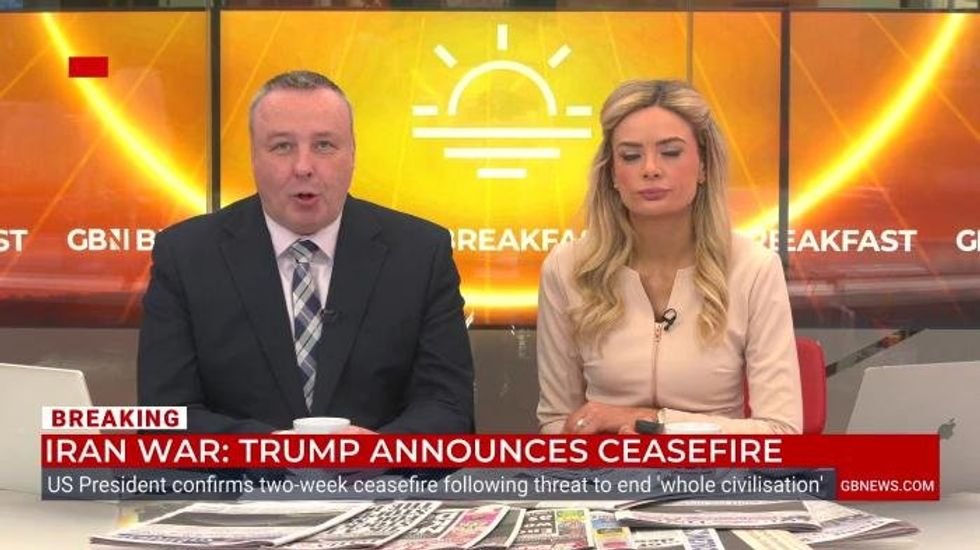
Ships have passed through the Strait of Hormuz for the first since since President Donald Trump halted strikes on Iran. The US and Iran agreed a two-week ceasefire last night, in which the Islamic Republic agreed to open up the critical shipping lane after blocking it in retaliation to strikes. There are roughly 800 ships waiting to pass through the strait. GB News has monitored shipping traffic and it appears a ship sailing under the St Kitts and Nevis flag has passed through the shipping lane.Another ship, under the Maltese flag is currently entering the strait. The vital waterway, in which typically 20 per cent of the world’s oil passes through, was blocked by Iran on March 2. However, since the ceasefire was agreed by the US and Iran, brokered by the Pakistani Government, the Islamic Republic confirmed ships could pass through the strait, so long as vessels liaise with Iranian military.In a statement, Iranian Foreign Minister Abbas Araghchi said: “For a period of two weeks, safe passage through the Strait of Hormuz will be possible via coordination with Iran’s Armed Forces and with due consideration of technical limitations.”The Strait of Hormuz has begun to open up to commercial ships after been blocked for weeks (stock image) | GETTYThis comes after President Trump declared he would destroy Iran’s “whole civilisation” on Tuesday after his deal deadline for Iran loomed.At the 11th hour, the US President announced a fortnight-long ceasefire had been struck, on the proviso that Iran opens the shipping waterway immediately. He wrote on his social media platform, Truth Social, on Tuesday night: “Subject to the Islamic Republic of Iran agreeing to the COMPLETE, IMMEDIATE, and SAFE OPENING of the Strait of Hormuz, I agree to suspend the bombing and attack of Iran for a period of two weeks.”This will be a double sided CEASEFIRE! The reason for doing so is that we have already met and exceeded all military objectives, and are very far along with a definitive agreement concerning long-term peace with Iran, and peace in the Middle East.”Iranians burn US and Israeli flags as react after the ceasefire announcement at the Enqelab square, in Tehran on April 8 | GETTYPakistani officials intervened after Mr Trump’s apocalyptic messaging towards Iran, requesting the US grants a two-week ceasefire and Iran opening up the Strait of Hormuz. The US President personally thanked the Pakistani Prime Minister, Shehbaz Sharif and armed forces chief, Asim Munir. Iran’s new Ayatollah, Mojtaba Khamenei, agreed to the conditional ceasefire, three Iranian officials told The New York Times – despite him being unconscious.Also playing a part in brokering the ceasfire was China, to which Mr Trump later confirmed had helped bring Iran to the negotiating table.Since the closure of the strait at the end of February, the global price of oil soared.Petrol pumps across the UK reflected the strain on oil’s supply, with prices per litre as much as 40p higher than before the Iranian conflict kicked off on February 28. Concerns spread across the globe on how a limited oil supply would impact nations domestically, with some countries taking protectionary measures as a precaution. Pressure also was built up again the UK Government to take action – with demands from the Conservatives and Reform UK to allow oil and gas exploration in the North Sea and to lift fuel duty.